

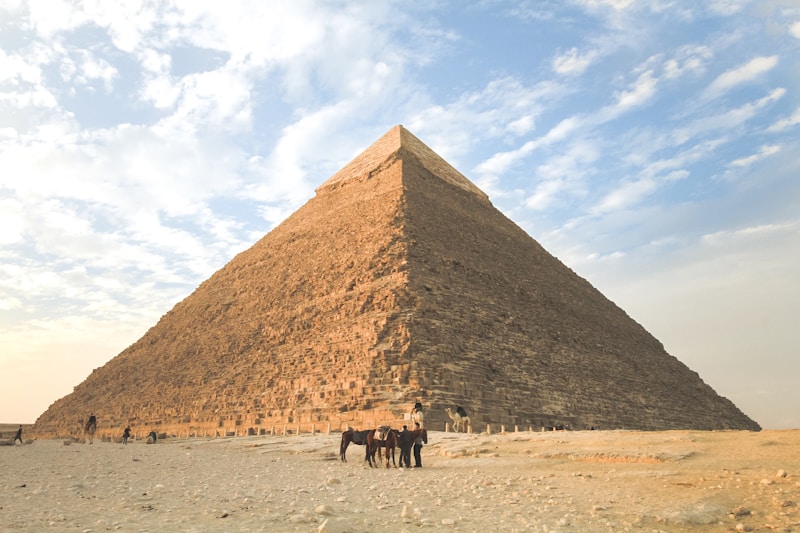
The Architectural Marvel of Giza
The Great Pyramid of Giza, built for the Pharaoh Khufu during the 26th century BC, stands as the ultimate testament to ancient Egyptian ingenuity. For over 3,800 years, it was the tallest man-made structure in the world. But the true wonder lies not in its height, but in the precision and logistical mastery required to construct it. Composed of approximately 2.3 million limestone and granite blocks, the total weight of the structure is estimated at 6 million tons. Each stone weighs an average of 2.5 tons, with some granite blocks in the King's Chamber weighing as much as 80 tons.
The Mystery of the Ramps
A central question that has baffled historians for centuries is how these massive stones were lifted to a height of 146 meters. The "Straight Ramp" theory suggests a massive, miles-long incline, but the sheer volume of material needed for such a ramp would equal that of the pyramid itself. Alternatively, the "Internal Ramp" theory, popularized by architect Jean-Pierre Houdin, proposes that the stones were moved through internal tunnels, allowing the structure to grow from the inside out. This theory is supported by modern scanning techniques that have identified density anomalies suggesting such passages exist.
Mathematical and Geometric Perfection
The precision with which the pyramid was built defies belief. Its base is level to within 15 millimeters, and the sides are aligned with the four cardinal points of the compass with an error of less than three-sixtieths of a degree. Furthermore, the ratio of the pyramid's perimeter to its height is equal to 2π, a mathematical constant that wouldn't be officially recognized for another thousand years. Whether this was intentional or a result of the measurement methods used, it adds a layer of mystical complexity to the site.
A Legacy in Stone
The construction of the Great Pyramid was not merely a construction project; it was a national endeavor that unified the entire Egyptian state. It required a vast bureaucracy, a sophisticated supply chain of water-borne transport via the Nile, and a dedicated workforce of skilled artisans and laborers who were proud to contribute to the "House of Eternity" for their divine king.